Fewer polygons, sharper edges.
A corner in the hillside can be the only thing keeping a route out of sight. Turn the slope far enough and the edges no longer overlap. An opening appears between two faces that looked joined from the previous position. Fadye Atelier uses those moments as the starting point for geometric exploration.
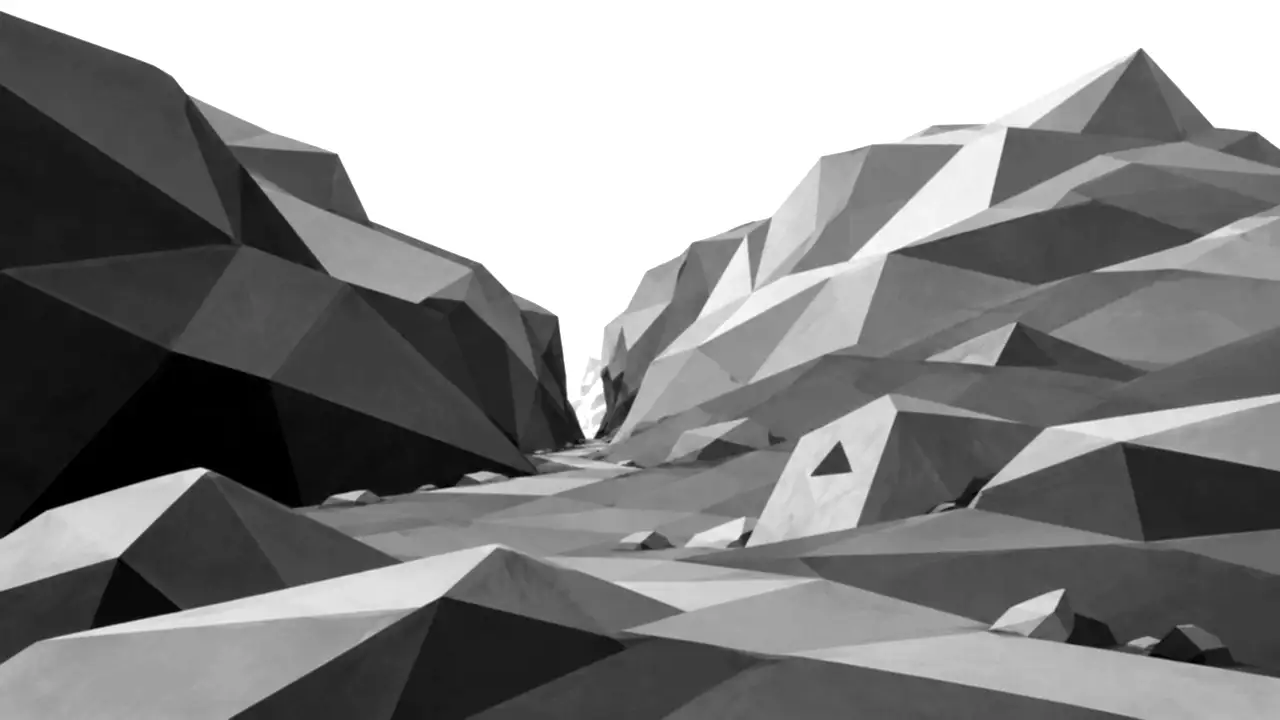
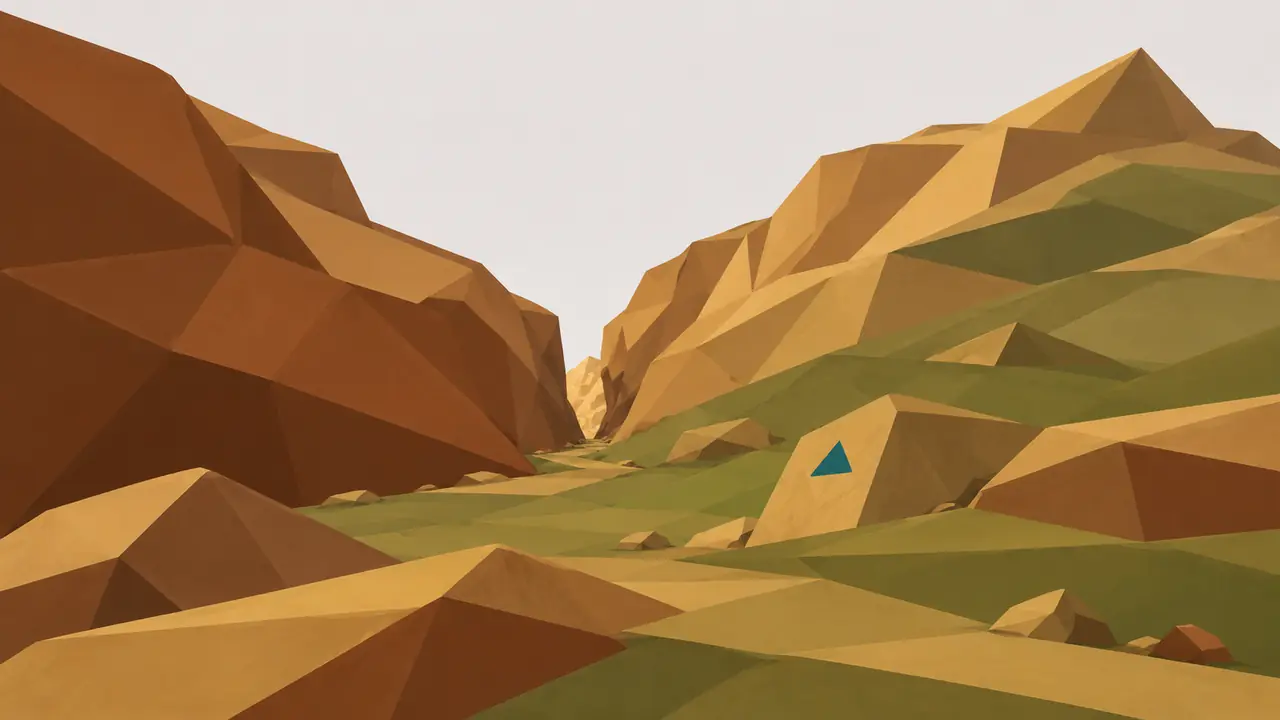
Move the comparison in either direction to inspect the ridge by outline and by surface. The ruler identifies the part of the study you are reading. Near the outline end, the pass and its neighboring peaks remain simple silhouettes. Near the surface end, small changes of plane give you evidence about where the faces meet. The case studies show how a player can use both observations in the terrain.
Follow a line that belongs to more than one face
The Hinged Ridge asks an explorer to turn a connected pair of hills until the shadow of one no longer covers a narrow pass. You bring the first face into position and use its hard edge as a reference while checking the second. The game is about noticing where each shape can stop, then making the path continuous.
Under the Cut follows a descent through an abandoned quarry. A cut slab can be pushed through a short range of angles. The position that fits the upper section can conceal the bottom of the same route. Here the explorer needs to look from below before making the final adjustment.
Read the work at the scale of the decision
In Terrain Studies, the two cases share a few construction steps without using the same path. The ridge depends on a skyline you can restore. The quarry depends on a lower camera position and a small silhouette notch. The studies link back to the exact step being discussed.
Mesh Notes follows how the pair of concepts changes when a face is removed, a camera angle shifted or a surface made more readable. We draw enough geometry to help the explorer anticipate the next move. A convincing material can be as sparse as two planes catching light at different angles. The finished study remains useful when you can explain what one edge contributes to the route.